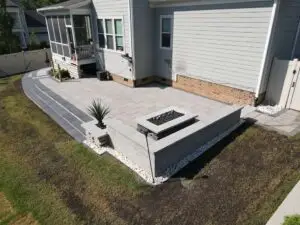
The side yard is one of the most overlooked spaces on any residential property. Squeezed between the house and the fence line, it’s typically treated as a utility corridor — somewhere to drag the trash cans, run a garden hose, or store equipment — rather than a designed part of the home’s outdoor living space. But in Raleigh, Angier, Cary, Apex, Durham, and the wider Triangle area, more and more homeowners are discovering that a side yard passage, properly designed and built, can become one of the most functional and visually impressive features of the entire property.
At Mauricio’s Landscaping LLC, we’ve spent 17 years transforming neglected side yards into beautiful, welcoming paver walkways throughout central North Carolina. Here’s how to do it right.
Why the Side Yard Deserves More Attention
Most side yards share a handful of characteristics that make them feel like afterthoughts rather than features: they’re narrow, shaded at certain times of day, prone to collecting water and debris, and sandwiched between the house wall and a fence or neighboring property. Left unimproved, they stay muddy, weed-prone, and uninviting.
But those same characteristics also make the side yard an ideal candidate for a paver walkway installation:
- The narrow corridor is already defined. Unlike a backyard where you have to decide where to put a path, the side yard gives you a natural beginning and end — from the front gate to the back gate — and a clear, bounded space to work within.
- It’s a high-traffic utility path. If you’re using the side yard to move between front and back, a properly built paver walkway immediately improves daily life — no more muddy footprints, uneven ground, or dodging puddles after rain.
- The transformation is dramatic. Few hardscaping projects produce a more striking before-and-after than a well-designed side yard walkway. The contrast between a neglected dirt-and-grass passage and a finished paver path with curved edging, warm tones, and planted beds on either side is immediate and undeniable.
- It connects your outdoor living spaces. A side yard walkway isn’t just a path — it’s the link between your front yard curb appeal and your backyard entertaining space, making both feel more cohesive and intentional.
Step 1: Assess the Space and Set Your Goals
Before any design work begins, the side yard needs to be measured and evaluated carefully.
- Measure the total width available. The usable width of the passage — from house wall to fence line — determines how wide the walkway can be and whether there’s room for planting beds on one or both sides.
- Identify any obstructions. HVAC units, downspout extensions, utility access panels, and hose bibs all need to be accounted for in the layout. A well-designed side yard walkway works around these elements rather than ignoring them.
- Assess the drainage situation. Side yards are notorious for collecting and channeling water from both the roof and surrounding grade. Understanding how water moves through the space before designing the walkway prevents chronic drainage problems after installation.
- Define the entry and exit points. Where does the side yard connect to the front yard — through a gate, past a fence panel, or open to the driveway? Where does it open to the backyard? These transition points anchor the walkway design and determine how the path starts and ends.
Step 2: Design the Path — Straight or Curved
The choice between a straight or curved side yard walkway is partly aesthetic and partly practical.
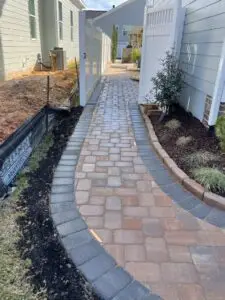
- Straight walkways are the natural choice for very narrow side yards where there simply isn’t room for a curve, or for formal home styles where a direct, precise line suits the architecture. A straight path with a strong two-tone paver design — warm field pavers with a contrasting gray border — still delivers tremendous visual impact even without a curve.
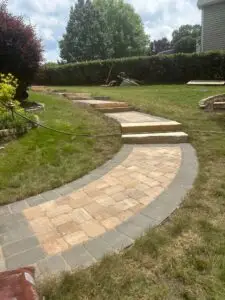
- Curved walkways work beautifully in side yards that have enough width to allow a gentle arc. A curve softens what would otherwise be a tunnel-like corridor, creates a sense of movement and invitation, and allows the path to navigate gracefully around HVAC units, downspouts, or existing plantings. The sweeping curved side yard walkways we build throughout Raleigh and the Triangle area — warm brick-toned pavers with a charcoal border curving from front gate to back — are among the most visually impressive results we produce.
- Curved edging on a straight path. Even when the centerline of the walkway runs straight, curving the edging of planting beds on one or both sides of the path adds visual softness and creates room for varied plant heights and textures alongside the walkway.
Step 3: Choose a Paver Design That Makes the Space Feel Larger
Material and pattern selection in a side yard walkway has to account for the visual psychology of a narrow space — the right choices make it feel wider and more welcoming; the wrong ones make it feel more cramped.
- Warm tones open the space. Pavers in terra cotta, buff, red brick, and warm beige tones catch available light and reflect it back — making a shaded or enclosed side yard feel brighter and more welcoming than cooler gray or charcoal tones, which recede and can make a narrow corridor feel darker.
- A contrasting border anchors and widens. A darker border paver — charcoal gray, dark brown, or slate — running along both edges of the walkway creates a visual frame that actually makes the path read as wider than it is. The eye follows the border line, not the wall or fence behind it.
- Herringbone and running bond patterns both work well. A herringbone pattern adds visual richness and interlocks the pavers tightly — excellent for side yards where the path sees frequent foot traffic and needs long-term stability. A running bond or stacked bond pattern reads cleaner and more contemporary. Both are strong choices depending on the home’s overall style.
- Consistent sizing throughout. As with any walkway, using a single paver size maintains the clean, deliberate look that a well-designed side yard path requires.
Step 4: Add Planting Beds on One or Both Sides
Nothing transforms a side yard walkway from a utilitarian path to a welcoming feature faster than well-designed planting beds alongside the pavers.
- Even one side makes a difference. In a very narrow side yard where there’s only room for a bed on one side — typically the fence or property line side rather than the house wall side — a planted bed with mulch, low shrubs, and seasonal color completely changes the character of the space.
- Use vertical plants strategically. Narrow, columnar plants — Italian cypress, sky pencil holly, columnar arborvitae — are ideal for side yard planting beds because they add height and greenery without spreading into the walkway or blocking the path.
- Ground-level plants soften the paver edge. Low-growing ornamental grasses, liriope, or creeping phlox planted at the edge of the bed closest to the walkway soften the transition between hardscape and landscape and add seasonal texture and movement.
- Mulch keeps the space clean. A consistent layer of dark mulch in the planting beds alongside the walkway keeps weeds down, retains moisture for plants, and provides a clean visual contrast against the warm paver tones — one of the most impactful finishing details in any side yard walkway project.
Step 5: Handle Drainage Before You Install
Water management is critical in any side yard walkway project — and it’s the element most likely to cause problems if it’s not addressed before the first paver is set.
- Grade the base away from the house foundation. The compacted base beneath the pavers should slope gently away from the house wall — typically a 1–2% grade — to direct water toward the yard side rather than allowing it to pool against the foundation.
- Account for roof runoff. Downspouts along the house wall release significant water volumes during NC rainstorms. Make sure downspout extensions direct water past the walkway surface and into a drainage outlet or away from the paved area.
- Consider a channel drain if needed. Side yards that collect heavy water flow during rain events may benefit from a narrow channel drain set flush with the walkway surface at the low point of the path. This keeps water moving through rather than pooling on the paved surface.
- Use polymeric joint sand. Polymeric sand in the paver joints resists washout better than standard sand and maintains joint stability through NC’s wet seasons — essential in a side yard where water volume through the corridor can be significant.
Step 6: Finish the Entry and Exit Points With Care
The points where the side yard walkway meets the front yard and backyard are the moments that define how welcoming the path feels — and they deserve as much attention as the walkway itself.
- Frame the entry with plants or pillars. A pair of columnar plants, potted specimens, or low masonry pillars on either side of the walkway entry point creates a gateway moment — a clear signal that the path is intentional and inviting rather than incidental.
- Match the gate hardware to the overall design. If the side yard entry includes a fence gate, the hardware should coordinate with the walkway’s aesthetic — a black powder-coated gate latch and hinges read as intentional and finished alongside a warm-toned paver path.
- Connect cleanly to the backyard surface. Where the side yard walkway meets a patio, pool deck, or open lawn at the back, the transition should be planned carefully — a clean edge, a small landing pad, or a simple step if there’s a grade change creates a finished, professional result.
The Side Yard You Walk Past Every Day Can Become One of Your Favorite Features
A side yard that’s spent years as a muddy utility corridor doesn’t have to stay that way. With the right paver design, proper drainage planning, and a few well-chosen plants, it becomes a path you actually enjoy walking — a feature that adds real curb appeal to your front yard, real functionality to your daily routine, and real value to your home.
Transform Your Side Yard With Mauricio’s Landscaping LLC
At Mauricio’s Landscaping LLC, we’ve spent 17 years designing and building side yard walkways, front yard paths, retaining walls, patios, seat walls, outdoor kitchens, pool decks, and drainage systems for homeowners throughout Raleigh, Angier, Cary, Apex, Durham, and the surrounding Triangle area. Every project is custom-designed for your space, your home’s style, and your long-term goals.
Ready to turn your side yard into a walkway worth showing off? Contact us today or call (919) 633-8306 for your free estimate.
Facebook
Pinterest
Twitter
LinkedIn

Latest Post
September 11, 2026

Free Estimate
Get professional landscaping and hardscaping solutions tailored to your outdoor project needs.
Transform Your Outdoor Space With Confidence
Mauricio’s Landscaping LLC delivers professional patios, retaining walls, outdoor kitchens, and hardscaping solutions designed to enhance the beauty and functionality of your property.
At Mauricio’s Landscaping LLC, we provide patios, retaining walls, outdoor kitchens, walkways, and hardscaping services for residential and commercial properties in Angier, Raleigh, Cary, Apex, Durham, and surrounding North Carolina areas.
Navigation
Services
Copyright © 2026 Mauricio’s Landscaping LLC. Powered By Orbis Advisers