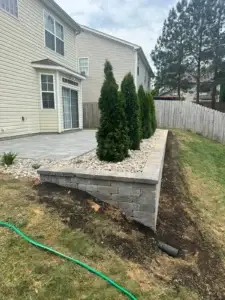
A deck surface made of one paver color, laid in one continuous field, can look flat even when the pavers themselves are beautiful. The difference between a surface that feels simply installed and one that feels designed often comes down to the edges. A border band, a contrasting edge, or a defined perimeter frames the whole space, gives the eye somewhere to land, and makes a deck look finished. For homeowners in Angier, Raleigh, Cary, Apex, Durham, and the wider Triangle area, adding a contrast edge is one of the most effective ways to elevate a paver deck without changing its basic layout.
At Mauricio’s Landscaping LLC, we’ve spent 17 years building pool decks, patios, walkways, and retaining walls throughout central North Carolina. Here’s how border bands and contrast edges work, and how to choose the right one for your deck.
What Border Bands and Contrast Edges Actually Do
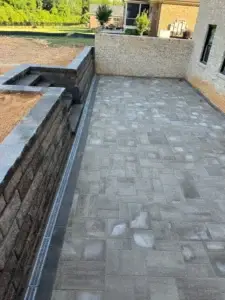
A border band is a row, or several rows, of pavers set along the perimeter of a deck in a different color, size, or orientation than the main field. A contrast edge is the same idea applied to a single outer course, often a darker or lighter paver that traces the outline of the space.
- They frame the space. Just as a picture frame separates artwork from the wall, a border separates the paver field from the surrounding lawn, planting beds, or pool coping. The deck reads as a deliberate, bounded feature instead of a surface that simply stops.
- They add visual interest without adding clutter. A single contrasting band introduces a second tone and a clean line, which gives a large paver surface structure without making it busy.
- They define shape. Curves, corners, and angles are far easier to see when they’re outlined. A border band traces the geometry of a rectangular deck or follows the sweep of a curved edge, making the design look intentional.
- They improve safety. A change in color or tone at the edge of a deck helps people see where the surface ends, particularly near steps, grade changes, and the water’s edge.
- They hide minor cuts. Where a deck meets curves, corners, or irregular boundaries, a border course gives the installer a clean place to finish the pattern, so cut pavers look planned rather than patched.
Choosing a Contrast Color That Works
The color relationship between the field and the border sets the personality of the whole deck. A few approaches work especially well in North Carolina backyards.
- Darker border on a lighter field. A charcoal or deep gray border around a light gray or buff field is one of the most popular combinations. The dark edge creates a strong, crisp outline, and the lighter field stays cool underfoot in summer sun.
- Lighter border on a darker field. Reversing the contrast can make a deck feel more open and relaxed, especially in shaded yards where a lighter edge catches available light.
- Tone-on-tone borders. For a subtle look, choose a border in the same color family as the field but a shade or two different. This gives definition without strong contrast and suits modern, understated designs.
- Match the home and surroundings. The best border color often echoes something already present, such as the roofline, trim, brick, or a nearby retaining wall. This ties the deck to the rest of the property.
- Test with samples in your yard. Paver colors look different in direct sun, shade, and evening light. Setting samples in the actual space before you commit helps you see how the contrast will read throughout the day.
Border Width, Pattern, and Orientation
Color is only part of the design. How wide the border is and how the pavers are laid also change the look.
- Single-course borders. One row of pavers around the perimeter creates a clean, minimal frame. This works well on contemporary decks and around pools where you want a crisp line without a heavy visual weight.
- Double or triple borders. Wider bands add presence and can be used to mark transitions, such as the edge of a seating area or the boundary between a deck and a walkway. Wider borders suit larger spaces where a thin line might disappear.
- Soldier course versus sailor course. Pavers set end to end along the perimeter, called a soldier course, read as a smooth continuous line. Pavers set on their sides, called a sailor course, create a bolder, more textured edge. Each has its own character, so the choice depends on how pronounced you want the border to be.
- Contrasting direction. Even when the border and the field use the same color, laying the border pavers perpendicular to the field pattern creates a subtle frame through direction alone.
- Scale relative to the space. A border should feel proportionate. A very wide band on a small deck can overwhelm it, while a thin line on a large surface can seem like an afterthought. A good rule is to let the size of the space guide the weight of the border.
Using Borders Around Pools, Steps, and Transitions
Borders earn their keep in the places where a deck meets something else. Several details are worth planning carefully.
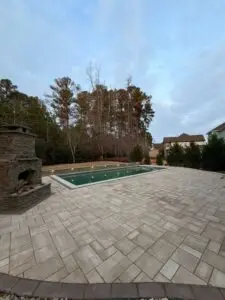
- Along the pool coping. A contrast band beside the coping makes the pool edge easier to see and gives the water a defined outline. It also creates a clean transition between coping material and the main paver field.
- At steps and landings. Using a border color on step treads or nosing helps people recognize each step and reduces tripping hazards, especially in low light.
- Where the deck meets lawn or planting beds. A border course acts as a finished edge against grass and mulch. Pairing it with proper edge restraints keeps the paver field stable and the line crisp over time.
- Between different zones. Borders can separate a lounge area from a dining area, or a deck from a walkway, creating visual structure without needing walls or other barriers.
- Around features. Fire pits, planters, and equipment pads can be outlined with a contrasting paver course so that they look integrated into the design rather than dropped onto the surface.
Installation Details That Keep the Edge Looking Sharp
A beautiful border depends on how it’s built. Because the perimeter takes the most stress from foot traffic, water, and soil movement, installation details matter.
- Rigid edge restraints. Edge restraints lock the outer course in place and prevent the paver field from spreading. Without them, borders can shift, open joints, and lose their clean line over time.
- Consistent joint width. Even spacing makes a border look precise. Spacers and string lines help keep the perimeter straight and the curves smooth.
- Precise cuts at curves and corners. Curved borders require careful cutting so the joints remain tight and even. Corners should be mitered or laid out so that the pattern turns cleanly.
- Polymeric joint sand. Polymeric sand resists washout from rain and pool splash, which helps keep border joints stable in North Carolina’s wet seasons.
- Proper base preparation. The border sits on the same compacted aggregate base as the field. A well-built base is what keeps a contrast edge level, straight, and attractive for years.
Final Thoughts
Border bands and contrast edges are small design decisions with a big visual payoff. By choosing a thoughtful color relationship, sizing the border to suit your space, and building the edge with proper restraints and base preparation, you turn an ordinary paver deck into a defined, polished outdoor feature that looks intentional from every angle.
At Mauricio’s Landscaping LLC, we design and build pool decks, patios, walkways, retaining walls, outdoor kitchens, and drainage systems for homeowners throughout Angier, Raleigh, Cary, Apex, Durham, and the surrounding Triangle area. Every project is custom-designed for your yard, your home’s style, and the way you want to use your outdoor space.
Ready to give your deck a more finished look? Contact Mauricio’s Landscaping LLC today for your free estimate.
Facebook
Pinterest
Twitter
LinkedIn
Latest Post
November 6, 2026
October 23, 2026
October 15, 2026
Free Estimate
Get professional landscaping and hardscaping solutions tailored to your outdoor project needs.
Transform Your Outdoor Space With Confidence
Mauricio’s Landscaping LLC delivers professional patios, retaining walls, outdoor kitchens, and hardscaping solutions designed to enhance the beauty and functionality of your property.
At Mauricio’s Landscaping LLC, we provide patios, retaining walls, outdoor kitchens, walkways, and hardscaping services for residential and commercial properties in Angier, Raleigh, Cary, Apex, Durham, and surrounding North Carolina areas.
Navigation
Services
Copyright © 2026 Mauricio’s Landscaping LLC. Powered By Orbis Advisers