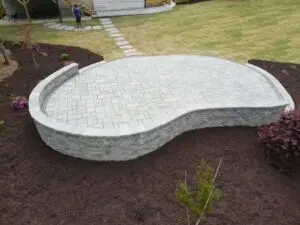
A raised planting bed built with retaining wall blocks does something that a simple garden border or landscape edging can’t — it creates a permanent, structured feature that adds real visual weight to a backyard, defines outdoor spaces with intention, and gives plants a clean, elevated stage that reads as designed rather than incidental. For homeowners in Raleigh, Angier, Cary, Apex, Durham, and the wider Triangle area, a block-built raised bed is also one of the most practical landscaping investments available: it improves drainage, reduces weeding and maintenance, and holds its shape and structure through NC’s seasons without settling, rotting, or needing replacement.
At Mauricio’s Landscaping LLC, raised planting beds built with retaining wall blocks are one of the features we design and install most frequently alongside patios, walkways, and hardscaping projects. Here’s what goes into getting them right.
Why Retaining Wall Blocks Work So Well for Raised Planting Beds
Not every material used for raised planting beds performs equally well over time — and in North Carolina’s climate, the wrong choice shows its weaknesses within a few seasons. Retaining wall blocks — the same interlocking concrete masonry units used for full-scale retaining walls — have characteristics that make them particularly well suited for raised bed construction.
- Structural integrity. Retaining wall blocks are engineered to hold weight and resist lateral pressure. A raised planting bed filled with amended soil, gravel, and river rock puts continuous outward pressure on its walls — and a properly built block wall handles that pressure cleanly, maintaining its face and alignment over years without bowing, shifting, or settling.
- Drainage by design. Unlike solid poured concrete borders or timber-framed beds, retaining wall block systems allow water to pass through the wall system rather than trapping it behind the face. This is critical in NC’s rainy seasons — a raised bed that can’t drain freely becomes waterlogged, which damages plant roots and accelerates deterioration of the wall structure.
- Durability through freeze-thaw cycles. North Carolina’s winters bring enough freeze-thaw activity to crack and heave materials that weren’t designed for it. Quality retaining wall blocks are rated for repeated freeze-thaw cycling — they maintain their dimensional stability and face integrity through winter in ways that softer stone, untreated timber, and low-grade concrete products don’t.
- Design flexibility. Retaining wall blocks are available in a wide range of profiles, textures, and color blends — from tumbled natural stone looks to clean, contemporary smooth-face units — and they can be stacked to virtually any height and shaped to follow straight lines, gentle curves, or complex geometric layouts.
Block Style, Color, and Height: Making the Right Design Choices
The three decisions that most affect how a finished raised planting bed looks in your specific yard are block profile, color blend, and wall height — and each one interacts with the others in ways worth thinking through before the first block is set.
- Block profile. The face texture of the block determines the visual character of the finished wall. Tumbled or rough-split face blocks read as naturalistic and relaxed — they complement yards with organic landscaping, mature trees, and informal planting arrangements. Smooth or lightly textured face blocks read as cleaner and more contemporary — they pair well with structured paver patios, geometric layouts, and modern home exteriors. Choosing a block profile that matches the existing style of your home and yard produces a wall that looks intentional rather than arbitrary.
- Color blend. Most retaining wall block lines offer multiple color options — typically ranging from warm tans and buffs to cool charcoals and grays. The most successful raised bed installations use a block color that either complements or intentionally contrasts with the adjacent hardscape. A gray-toned block alongside a charcoal paver patio creates cohesion; the same gray block against a warm travertine surface creates a deliberate contrast that can be equally effective when it’s planned rather than accidental.
- Wall height. Single-course raised beds — one row of blocks, typically 6–8 inches above grade — define a planting area without creating significant visual mass. Two- and three-course raised beds — 12–24 inches above grade — function more like true landscape features: they add meaningful elevation change to a flat yard, create visual anchors that organize the surrounding space, and give taller plantings a platform that makes them read more dramatically against the sky and fence line. For most residential backyards in the Triangle area, a two-course raised bed strikes the ideal balance between visual presence and proportional fit.
Shape and Layout: Designing a Raised Bed That Fits Your Yard
The shape and placement of a raised planting bed relative to the rest of the yard — and particularly relative to any adjacent patio, walkway, or fence line — is what determines whether the finished bed feels like a deliberate part of the landscape design or a feature that was added as an afterthought.
- Follow the geometry of adjacent hardscape. A raised bed positioned parallel to a paver patio, running along the same axis and maintaining a clean, consistent setback from the patio edge, creates a relationship between the two features that makes both look more intentional. A bed that sits at an odd angle to the patio or pinches into the lawn without a clear relationship to the surrounding hardscape rarely looks as resolved.
- Use corners and edges deliberately. The corners of a raised retaining wall bed — whether square, angled, or radiused — are the most visually prominent detail of the structure. Square corners read as crisp and formal; radius corners softened with curved block units read as more relaxed. The corner treatment should match the overall character of the installation and the home’s exterior style.
- Size relative to the planting. A raised bed should be sized for the mature scale of the plants it will contain — not just what they look like at planting time. Columnar evergreens like arborvitae, which are compact at installation but grow to 8–15 feet at maturity, need enough bed depth and width to look proportional to their eventual size. Undersizing a raised bed for the plants it’s designed to showcase is one of the most common planning mistakes in residential landscaping.
- Leave room for ground cover. The area inside the raised bed between and around the base of plantings should be accounted for in the design — whether that’s river rock, decorative gravel, or mulch. River rock in particular is one of the most popular ground cover choices for raised beds in the Triangle area: it suppresses weeds without decomposing, drains freely, and provides a clean visual contrast against dark green evergreens and gray block walls.
What to Plant: Evergreens, Shrubs, and Ground Cover That Perform in NC
A raised planting bed is only as effective as what’s planted in it — and plant selection for NC backyards needs to account for the region’s heat, humidity, and occasional winter cold rather than defaulting to species that look good in photos but struggle in the Triangle area’s actual conditions.
- Columnar evergreens for vertical interest. Emerald Green Arborvitae is one of the most reliable choices for raised beds throughout central North Carolina — narrow, dense, and slow-growing enough to stay in scale with a residential raised bed for years without aggressive pruning. Sky Pencil Holly is another excellent option for a slightly more contemporary look. Both perform well in NC’s climate and pair naturally with the structured geometry of a block-built raised bed.
- Broadleaf evergreens for texture. Boxwood, Inkberry Holly, and Dwarf Nandina offer year-round foliage, moderate size at maturity, and tolerance for NC’s climate. Mixed into a raised bed alongside columnar evergreens, they add texture variety and prevent the planting from reading as too uniform.
- Ornamental grasses for movement. Low-growing ornamental grasses — Blue Fescue, Carex, or Liriope — planted at the base of taller evergreens in a raised bed add seasonal movement and soften the transition between the structured block wall and the planting above. They also perform well in the well-drained soil conditions that a raised bed naturally provides.
- River rock as the ground cover of choice. For raised beds where low maintenance is a priority — particularly beds bordered by pavers and adjacent to seating areas — river rock ground cover is the most practical finish. It drains immediately after rain, suppresses weeds far more effectively than mulch over time, and provides a clean, finished appearance that holds up through NC’s wet seasons without washing or decomposing.
Drainage and Soil Preparation: Getting the Foundation Right
A raised planting bed that looks beautiful at installation but struggles with plant health or wall movement within the first season is almost always the result of inadequate drainage or improper soil preparation inside the bed.
- Gravel base layer. Before planting soil is added, a layer of coarse gravel — typically 3–4 inches — should be placed at the base of the raised bed interior. This gravel layer creates a free-draining zone at the bottom of the bed that prevents waterlogging at the root zone, even during NC’s heaviest rainfall periods.
- Amended planting mix. The soil used to fill a raised bed should be a blended mix of topsoil, compost, and coarse sand or perlite — not straight native soil from the yard. Native NC soil, particularly in clay-heavy areas, compacts over time in a raised bed environment and drains poorly. A properly blended planting mix stays loose, drains freely, and supports healthy root development for the life of the plantings.
- Drainage outlet at the wall base. On raised beds where significant soil volume is enclosed — particularly taller, multi-course installations — a drainage outlet at the base of the wall on the low side allows excess water to exit the bed rather than building up pressure behind the block face. This is especially important for raised beds positioned adjacent to a fence line or structure where water has limited escape routes.
- Cap blocks seal and protect. The top course of a retaining wall raised bed should always be finished with cap blocks — flat capstone units that protect the top of the wall structure, shed water away from the wall face rather than into the joint system, and provide the clean finished edge that defines the top of the feature.
Final Thoughts
A raised planting bed built with retaining wall blocks is one of the most versatile and rewarding features you can add to a NC backyard — it organizes the landscape, creates a permanent planting structure that outlasts timber or plastic alternatives by decades, and adds the kind of visual presence that a flat planting bed at grade simply can’t match.
At Mauricio’s Landscaping LLC, we design and build raised planting beds, retaining walls, patios, walkways, pool decks, outdoor kitchens, and drainage systems for homeowners throughout Raleigh, Angier, Cary, Apex, Durham, and the surrounding Triangle area. Every project is custom-designed for your yard, your home’s style, and your long-term landscape goals.
Ready to add a raised planting bed that transforms your backyard? Contact Mauricio’s Landscaping LLC
Facebook
Pinterest
Twitter
LinkedIn
Latest Post
September 25, 2026
September 18, 2026
September 11, 2026
Free Estimate
Get professional landscaping and hardscaping solutions tailored to your outdoor project needs.
Transform Your Outdoor Space With Confidence
Mauricio’s Landscaping LLC delivers professional patios, retaining walls, outdoor kitchens, and hardscaping solutions designed to enhance the beauty and functionality of your property.
At Mauricio’s Landscaping LLC, we provide patios, retaining walls, outdoor kitchens, walkways, and hardscaping services for residential and commercial properties in Angier, Raleigh, Cary, Apex, Durham, and surrounding North Carolina areas.
Navigation
Services
Copyright © 2026 Mauricio’s Landscaping LLC. Powered By Orbis Advisers