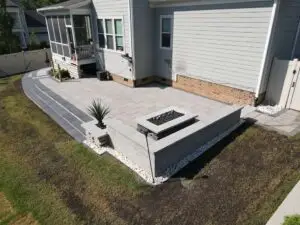
Your front yard walkway is the first hardscape feature anyone sees when they approach your home — and the last thing they notice when they leave. It sets the tone for your entire property, frames your home’s entrance, and tells visitors something about who you are before they even reach the front door. Yet in many homes throughout Raleigh, Angier, Cary, Apex, Durham, and the Triangle area, the front walkway is an afterthought — a narrow strip of concrete that does the bare minimum.
A thoughtfully designed front yard walkway changes all of that. At Mauricio’s Landscaping LLC, we’ve spent 17 years designing and installing front yard walkways throughout central North Carolina that are beautiful, durable, and built to last. Here’s your complete guide to designing a front walkway that connects your porch to the street the right way.
Why the Front Walkway Matters More Than You Think
The walkway from your porch to the street is the single most-used hardscape feature on your property. Every guest, delivery, and family member travels it multiple times a day. Its condition and design affect:
- Curb appeal. A wide, well-designed paver walkway framed by planting beds is one of the fastest ways to elevate a home’s exterior — and one of the most noticed by neighbors, guests, and potential buyers alike.
- Safety. A properly installed walkway with consistent, even pavers and good drainage keeps visitors safe in wet conditions — a real concern in NC’s frequent rain.
- Property value. In the competitive Triangle area real estate market, a professionally installed front walkway consistently delivers a strong return on investment.
- First impression. The path to your front door communicates the character of your home before anyone steps inside. A curved, landscaped walkway signals care, intention, and pride of ownership.
Step 1: Decide on Straight or Curved
The first and most fundamental design decision for any front yard walkway is whether to run it straight from the street to the porch or let it curve through the landscape.
- Straight walkways work best for formal home styles — colonial, traditional, or symmetrical facades — where a direct, centered path reinforces the architecture. They’re also the right choice when the front yard is narrow and there simply isn’t room for a graceful curve.
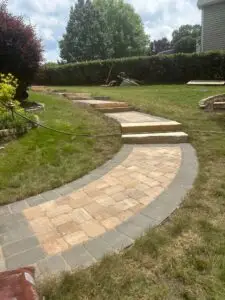
- Curved walkways are the most popular choice in Raleigh and the Triangle area for good reason. A gentle curve creates a sense of arrival, allows the walkway to work around existing trees, garden beds, or features, and produces a far more welcoming, organic feel than a straight line. The curve also naturally slows visitors down, giving them more time to take in the home’s exterior.
- The curve should feel natural, not forced. A good curved walkway follows the natural contour of the yard and moves with purpose — not a tight, awkward zigzag, but a broad, sweeping arc that leads the eye directly to the front door.
Step 2: Choose the Right Width
Walkway width is one of the most commonly underestimated design decisions — and one of the most visible mistakes when it goes wrong.
- Minimum 4 feet wide for a front walkway that allows two people to walk side by side comfortably — the standard for most residential installations in the Triangle area.
- 5 to 6 feet wide for a more generous, welcoming feel — particularly appropriate for larger homes, homes with prominent porches, or any property where curb appeal is a priority.
- Widen at the street end and porch end. Many of the most elegant front walkway designs flare slightly wider at both ends — at the sidewalk connection and at the porch steps — creating a natural funnel that guides visitors in and makes the approach feel more intentional.
Step 3: Select Your Paver Material and Color
Material and color selection for a front walkway needs to balance aesthetics, durability, and how well the choice complements the home’s exterior.
- Large-format concrete pavers in gray or silver tones are the most popular front walkway choice throughout Raleigh, Cary, and the Triangle area. They’re clean, contemporary, and versatile enough to complement virtually any home exterior — from classic craftsman to modern farmhouse.
- Mixed-format paver patterns — combining two or three paver sizes in a running bond or random ashlar pattern — add visual interest and a custom feel without adding complexity to maintenance.
- Warm earth tones (buff, tan, sandstone) work beautifully with brick or traditional home exteriors and pair naturally with mulched planting beds along the walkway edges.
- Match or complement the porch steps. If your home has existing concrete or paver porch steps, the walkway material should coordinate closely. Using the same paver for both the walkway and the step faces creates a seamless, intentional look — like the front entries we regularly build throughout Angier and Raleigh.
- Avoid very dark pavers in full sun. Dark pavers absorb heat significantly in NC’s summer sun — a consideration when guests will be walking on the surface barefoot or in sandals.
Step 4: Integrate the Planting Beds
A front yard walkway doesn’t exist in isolation — it’s framed by whatever is on either side of it, and that framing makes an enormous difference in the final result. Planting beds alongside a front walkway are one of the highest-impact curb appeal investments you can make alongside the hardscape itself.
- Define bed edges cleanly. Metal or steel edge restraints along the walkway border keep mulch and soil off the pavers and maintain the crisp line between hardscape and landscape — a detail that elevates the finished look significantly.
- Layer plant heights. Low groundcovers and perennials near the walkway edge, mid-height shrubs and ornamentals in the middle, and taller plants or small trees at the back create depth and visual interest from the street.
- Choose NC-appropriate plants. Native and adapted perennials — coneflowers, black-eyed Susans, ornamental grasses, hostas, and knockout roses — thrive in central NC’s climate, require less maintenance, and look beautiful alongside paver walkways from spring through fall.
- Use mulch generously. A consistent 2–3 inch layer of mulch in the planting beds keeps moisture in, weeds down, and gives the entire front yard a clean, maintained appearance that complements the walkway.
Step 5: Connect to the Porch Steps Properly
The transition from walkway to porch steps is a critical detail that’s often handled poorly — and immediately noticeable when it is.
- Align the walkway centerline with the steps. The walkway should lead directly and naturally to the center of the porch steps — not approach at an angle that requires an awkward turn at the last moment.
- Match step materials to the walkway. Using the same paver for the step treads and risers as the walkway field creates a unified, flowing connection from street to door. A complementary but different material — such as a natural stone step with a paver walkway — can also work beautifully when the colors coordinate.
- Size the step landing generously. The landing at the top of the steps where the walkway meets the porch should be wide enough for two people to stand comfortably — at least as wide as the walkway itself, ideally wider.
- Slope steps correctly. Each step tread needs a slight forward pitch so water drains off the front rather than pooling — a small detail with a big impact on long-term safety and surface condition.
Step 6: Plan for Drainage From the Start
North Carolina’s rainfall is consistent and sometimes heavy — and a front yard walkway needs to be designed to handle water properly from day one.
- Grade the base away from the home. The compacted gravel and sand base beneath the walkway pavers should slope slightly away from the house foundation on both sides.
- Avoid low spots along the path. Any dip or depression in the walkway will collect water after rain — proper base preparation and consistent grading prevents this.
- Use polymeric joint sand. Polymeric sand in the paver joints resists washout better than standard sand, maintaining joint stability and weed resistance through NC’s wet seasons.
- Coordinate with planting bed drainage. Mulched planting beds alongside the walkway should be graded to drain away from the path, not toward it.
The Result: A Front Entry That Makes a Lasting Impression
A well-designed front yard walkway — wide, properly curved, built from quality pavers that complement your home’s exterior, framed by healthy planting beds, and connected cleanly to your porch steps — transforms the entire character of your home’s street presence. It’s one of the few hardscape investments that delivers immediate visual impact, long-term durability, and consistent returns in property value.
Design Your Front Walkway With Mauricio’s Landscaping LLC
At Mauricio’s Landscaping LLC, we’ve spent 17 years designing and building front yard walkways, patio installations, retaining walls, seat walls, outdoor kitchens, pool decks, and drainage systems for homeowners throughout Raleigh, Angier, Cary, Apex, Durham, and the surrounding Triangle area. Every walkway we build is custom-designed for your home’s architecture, your yard’s layout, and your long-term curb appeal goals.
Ready to give your home the front entry it deserves?
Contact us today or call (919) 633-8306 for your free estimate.
Facebook
Pinterest
Twitter
LinkedIn

Latest Post
September 11, 2026

Free Estimate
Get professional landscaping and hardscaping solutions tailored to your outdoor project needs.
Transform Your Outdoor Space With Confidence
Mauricio’s Landscaping LLC delivers professional patios, retaining walls, outdoor kitchens, and hardscaping solutions designed to enhance the beauty and functionality of your property.
At Mauricio’s Landscaping LLC, we provide patios, retaining walls, outdoor kitchens, walkways, and hardscaping services for residential and commercial properties in Angier, Raleigh, Cary, Apex, Durham, and surrounding North Carolina areas.
Navigation
Services
Copyright © 2026 Mauricio’s Landscaping LLC. Powered By Orbis Advisers