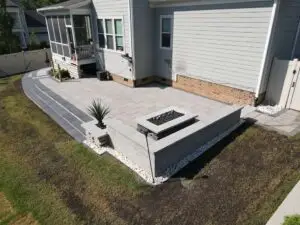
A sloped yard presents one of the most common landscaping challenges for homeowners throughout Angier, Raleigh, Cary, Apex, Durham, and the Triangle area — and one of the most rewarding to solve. A well-designed paver walkway with integrated steps doesn’t just make your yard more navigable; it transforms a difficult grade change into one of the most visually striking features of your entire property.
At Mauricio’s Landscaping LLC, we’ve designed and built curved paver walkways, natural stone step installations, and sloped yard solutions throughout central North Carolina for 17 years. Here’s everything you need to know about planning a paver walkway with steps for a sloped yard in Angier, NC.
Why Sloped Yards Need More Than a Straight Path
A flat yard can handle a simple straight walkway without much planning. A sloped yard is a different challenge entirely — one that requires careful attention to grade, drainage, step placement, and material selection before a single paver is set.
- Safety first. A walkway that doesn’t account for slope properly becomes slippery, uneven, and potentially dangerous — especially after rain, which NC gets plenty of year-round.
- Erosion control. Without proper edging, steps, and drainage built into the walkway design, water running down a sloped yard can erode the path and surrounding lawn over time.
- Aesthetic opportunity. A sloped yard that’s handled well — with a gently curving walkway and integrated natural stone or paver steps — becomes a focal point rather than a problem. The grade change adds visual depth and dimension that a flat yard simply can’t offer.
- Property value. A professionally designed sloped walkway with steps consistently ranks among the highest-impact curb appeal improvements in the Triangle area real estate market.
Assess the Grade and Plan the Path
Before choosing materials or laying out a design, the slope of the yard needs to be measured and mapped.
- Calculate the rise and run. The total elevation change (rise) and the horizontal distance of the walkway (run) determine how many steps are needed and how they should be spaced. A comfortable outdoor step typically has a rise of 6–7 inches and a run (tread depth) of at least 12–14 inches.
- Identify natural transition points. Look for spots in the yard where the slope changes or flattens — these are natural locations for step landings, which break up the grade and give walkers a moment to pause and reorient.
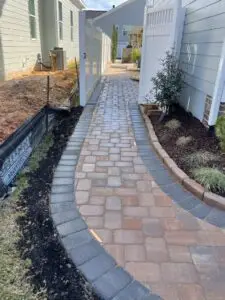
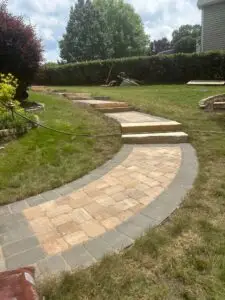
- Choose a curved or straight path. Curved walkways — like the two-tone paver design we frequently build throughout Angier and the Triangle area — follow the natural contour of a sloped yard more gracefully than a straight line and create a more welcoming, organic feel. Straight walkways work well for steeper, more direct grade changes.
- Plan for landings. Every two to four steps should be separated by a flat landing section — a wider, level paver area that gives the walkway rhythm and makes the grade change feel manageable rather than abrupt.
Choose Your Paver and Step Materials
Material selection for a sloped walkway with steps involves two decisions: the walkway surface and the step material. They can match, complement, or contrast — all three approaches produce beautiful results when done intentionally.
- Two-tone paver walkways — a field paver in one color with a contrasting border in a darker tone — are one of the most popular choices in the Triangle area. The border defines the walkway edges clearly, which is especially important on a sloped surface where the path needs to read cleanly against the lawn.
- Natural stone steps paired with a paver walkway create a beautiful material contrast — the organic texture and color variation of natural stone against the more uniform paver field adds visual richness and a high-end, custom feel.
- Matching paver steps — using the same paver for both the walkway and the steps — create a clean, cohesive look that reads as intentional and unified. This approach works especially well in contemporary or minimalist yard designs.
- Bluestone and sandstone are popular step materials in NC for their durability, natural slip resistance, and warm color palette that pairs well with earth-toned pavers.
- Tumbled or textured paver finishes are preferred over smooth, polished surfaces on sloped walkways — the texture provides grip underfoot, which matters most on inclined surfaces and after rain.
Design the Steps for Safety and Comfort
Step design is where a sloped walkway goes from functional to exceptional. Getting the proportions right makes the difference between steps that feel natural to climb and steps that feel awkward or tiring.
- Maintain consistent riser height throughout. Inconsistent step heights are a tripping hazard — every riser in the walkway should be the same height from bottom to top.
- Size treads generously. Outdoor steps benefit from deeper treads than indoor stairs — a 14–16 inch tread depth gives walkers room to plant their full foot comfortably, especially useful when carrying items or navigating in the dark.
- Slope treads slightly forward. Each step tread should have a slight forward pitch (about ¼ inch per foot) so water drains off the front of the step rather than pooling on the surface.
- Use full-width steps. Steps that span the full width of the walkway plus a few inches on each side look more substantial and intentional than narrow steps that feel like an afterthought within the path.
- Add step lighting. Low-voltage recessed lights built into the face of each step riser make a sloped walkway dramatically safer and more beautiful after dark — one of the most impactful finishing touches on any NC sloped yard project.
Plan for Drainage
Water management is the most critical — and most often overlooked — element of any sloped walkway design in North Carolina. NC’s frequent and sometimes heavy rainfall means drainage has to be built into the design from the start, not addressed after the fact.
- Grade the base properly. The compacted gravel and sand base beneath the pavers should follow the natural slope of the yard, with careful attention to directing water away from the walkway edges and any structures nearby.
- Install edge restraints. Solid plastic or aluminum edge restraints along both sides of the walkway keep pavers from shifting as water and soil movement act on them over time.
- Consider a channel drain at the base of the steps. If the slope delivers significant water volume toward the bottom of the walkway during heavy rain, a narrow channel drain across the path at the lowest step keeps water from pooling and damaging the base layer.
- Use polymeric joint sand. Polymeric sand in the paver joints resists washout far better than regular sand — critical on a sloped surface where water moves across the walkway during every rainfall.
Integrate Retaining Elements Where Needed
On steeper slopes or where the walkway cuts across a significant grade change, small retaining walls along the sides of the path are often needed to hold back soil and create a clean, defined walkway corridor.
- Low retaining walls or landscape timbers along the uphill side of the walkway keep soil from encroaching onto the path after rain.
- Retaining walls at step landings hold back the grade on either side of the level landing area, creating a clean transition between the sloped lawn and the flat step surface.
- Integrated planting beds between the retaining elements and the walkway edge soften the hardscape and add color and texture — a popular finishing detail in Angier and Triangle area landscape builds.
The Result: A Sloped Yard Transformed
A sloped yard that once felt like a problem becomes one of your property’s most distinctive features when handled with the right design. A curved two-tone paver walkway with integrated natural stone steps, proper drainage, and thoughtful lighting doesn’t just solve a grade change — it creates a path that draws the eye, invites exploration, and makes a lasting first impression on anyone who visits your home.
Design Your Sloped Yard Walkway With Mauricio’s Landscaping LLC
At Mauricio’s Landscaping LLC, we’ve spent 17 years designing and building paver walkways, natural stone steps, retaining walls, patios, pool decks, outdoor kitchens, and drainage systems for homeowners throughout Angier, Raleigh, Cary, Apex, Durham, and the surrounding Triangle area. Every walkway we build is custom-designed for your yard’s specific grade, your home’s style, and your long-term maintenance goals.
Ready to turn your sloped yard into a standout feature? Contact us today or call (919) 633-8306 for your free estimate.
Facebook
Pinterest
Twitter
LinkedIn

Latest Post
September 11, 2026

Free Estimate
Get professional landscaping and hardscaping solutions tailored to your outdoor project needs.
Transform Your Outdoor Space With Confidence
Mauricio’s Landscaping LLC delivers professional patios, retaining walls, outdoor kitchens, and hardscaping solutions designed to enhance the beauty and functionality of your property.
At Mauricio’s Landscaping LLC, we provide patios, retaining walls, outdoor kitchens, walkways, and hardscaping services for residential and commercial properties in Angier, Raleigh, Cary, Apex, Durham, and surrounding North Carolina areas.
Navigation
Services
Copyright © 2026 Mauricio’s Landscaping LLC. Powered By Orbis Advisers